Due to the previous, more technical posts, I decided to write a less serious one this time. Douglas Adams, in his "Hitchikers Guide to the Galaxy" series, offers the following advise to those who aspire to fly.
"There is and art, it says, or, rather, a knack to flying.
The knack lies in learning how to throw yourself at the ground and miss.
Pick a nice day, it suggests, and try it.
The first part is easy.
All it requires is simply the ability to throw yourself forward with all your weight, and the willingness not to mind that it's going to hurt.
That is, it's going to hurt if you fail to miss the ground.
Most people fail to miss the ground, and if they are really trying properly, the likelihood is that they will fail to miss it fairly hard.
Clearly, it is this second part, the missing, which presents the difficulties.
One problem is that you have to miss the ground accidentally. It's no good deliberately intending to miss the ground because you won't. You have to have your attention suddenly distracted by something else when you're halfway there, so that you are no longer thinking about falling, or about the ground, or about how much it's going to hurt if you fail to miss it.
It is notoriously difficult to prize your attention away from these three things during the split second you have at your disposal. Hence most people's failure, and their eventual disillusionment with this exhilarating and spectacular sport.
If, however, you are lucky enough to have your attention momentarily distracted at the crucial moment by, say, a gorgeous pair of legs (tentacles, pseudopodia, according to phyllum and/or personal inclination) or a bomb going off in your vicinity, or by suddenly spotting an extremely rare species of beetle crawling along a nearby twig, then in your astonishment you will miss the ground completely and remain bobbing just a few inches above it in what might seem to be a slightly foolish manner.
This is a moment for superb and delicate concentration.
Bob and float, float and bob.
Ignore all considerations of your own weight and simply let yourself waft higher.
Do not listen to what anybody says to you at this point because they are unlikely to say anything helpful.
They are most likely to say something along the lines of "Good God, you can't possibly be flying!"
It is vitally important not to believe them or they will suddenly be right.
Waft higher and higher.
Try a few swoops, gentle ones at first, then drift above the treetops breathing regularly.
DO NOT WAVE AT ANYBODY.
When you have done this a few times you will find the moment of distraction rapidly becomes easier and easier to achieve.
You will then learn all sorts of things about how to control your flight, your speed, your maneuverability, and the trick usually lies in on not thinking too hard about whatever you do, but just allowing it to happen as if it were going to anyway.
You will also learn about how to land properly, which is something you will almost certainly screw up, and screw up badly, on your first attempt.
There are private flying clubs you can join which help you achieve the all-important moment of distraction. They hire people with surprising bodies or opinions to leap out from behind bushes and exhibit and/or explain them at the critical moments. Few genuine hitchhikers will be able to afford to join these clubs, but some may be able to get temporary employment at them."
Saturday, May 26, 2012

Thursday, June 2, 2011
Time dilation
According to Euclid, we live in a 3-dimensional world, being able to pinpoint our position using three coordinates: x, y and z. Einstein saw this in a different light- 4 dimensions. According to his special theory of relativity "The four dimensional space-time continuum of the theory of relativity , in its most essential formal properties, shows a profound relationship to the Euclidian geometrical space. In order to give due prominence to this relationship, we must replace the usual time coordinate t by an imaginary magnitude by (√-1)* ct proportional to it." Just as space is fluctuary, time changes as well.
One feature that distinguishes time from space in how it is changed, is that motion changes time relatively. To illustrate that, imagine that an observer, person A, is on a stationary platform, and I have another person, person B, also on that platform, sitting in a spaceship. They are both experiencing, at that moment the same rate of time. Now the spaceship launches and it is accelerating. If he is traveling at 0.5c (half the speed of light) What feels like one day to person B, is 1.15 relative days for person A. As he gets closer to the speed of light, 0.99c, one day for person B is over a week back at the platform. Time goes up rapidly from there. at0.99999999999999c, for one day for person B, person A is long dead having almost 2000 years pass on his platform.
This data is all based upon the Lorentz factor, which is represented by the equation below, with:
t = time
v = velocity
c = constant, the speed of light
 Rest Frame Time Elapsed per Day on Ship
v/c Days Years
0.0 1.00 0.003
0.1 1.01 0.003
0.2 1.02 0.003
0.3 1.05 0.003
0.4 1.09 0.003
0.5 1.15 0.003
0.6 1.25 0.003
0.7 1.40 0.004
0.8 1.67 0.005
0.9 2.29 0.006
0.95 3.20 0.009
0.97 4.11 0.011
0.99 7.09 0.019
0.995 10.01 0.027
0.999 22.37 0.061
0.9999 70.71 0.194
0.99999 223.61 0.613
0.999999 707.11 1.937
0.9999999 2236.07 6.126
0.99999999 7071.07 19.373
0.999999999 22360.68 61.262
0.9999999999 70710.68 193.728
0.99999999999 223606.79 612.621
0.999999999999 707114.60 1937.300
0.9999999999999 2235720.41 6125.261
0.99999999999999 7073895.38 19380.535
0.999999999999999 22369621.33 61286.634
Sincerely,
Space Cadet
One feature that distinguishes time from space in how it is changed, is that motion changes time relatively. To illustrate that, imagine that an observer, person A, is on a stationary platform, and I have another person, person B, also on that platform, sitting in a spaceship. They are both experiencing, at that moment the same rate of time. Now the spaceship launches and it is accelerating. If he is traveling at 0.5c (half the speed of light) What feels like one day to person B, is 1.15 relative days for person A. As he gets closer to the speed of light, 0.99c, one day for person B is over a week back at the platform. Time goes up rapidly from there. at0.99999999999999c, for one day for person B, person A is long dead having almost 2000 years pass on his platform.
This data is all based upon the Lorentz factor, which is represented by the equation below, with:
t = time
v = velocity
c = constant, the speed of light

v/c Days Years
0.0 1.00 0.003
0.1 1.01 0.003
0.2 1.02 0.003
0.3 1.05 0.003
0.4 1.09 0.003
0.5 1.15 0.003
0.6 1.25 0.003
0.7 1.40 0.004
0.8 1.67 0.005
0.9 2.29 0.006
0.95 3.20 0.009
0.97 4.11 0.011
0.99 7.09 0.019
0.995 10.01 0.027
0.999 22.37 0.061
0.9999 70.71 0.194
0.99999 223.61 0.613
0.999999 707.11 1.937
0.9999999 2236.07 6.126
0.99999999 7071.07 19.373
0.999999999 22360.68 61.262
0.9999999999 70710.68 193.728
0.99999999999 223606.79 612.621
0.999999999999 707114.60 1937.300
0.9999999999999 2235720.41 6125.261
0.99999999999999 7073895.38 19380.535
0.999999999999999 22369621.33 61286.634
Sincerely,
Space Cadet
Saturday, May 21, 2011
 |
High-Quality Photograph of a Black Hole |
Black holes are an well-known effect that is consistent with Einstein's theory. Black holes are an extremely dense region of space where even light cannot escape. The premise of this phenomena is that a massive object bends space-time. If that massive object was extremely dense, it would ultimately bend space-time so that the walls of the dent are vertical. If a light beam is traveling and encounters the black hole, it will be bent at a consistently increasing angle so that it loops back upon itself and continues circling. It is now trapped. Objects of mass can be caught in the same way. When they spiral to the center they will be crushed to extreme density.
 |
| Swartzschild Radius Formula |
A black hole is formes when a star collapses to a diameter equivelant to or past its Swartzschild Radius. The Swartzschild radius is a ratio of a spherical object's mass to its radius. The formula(left): Rs is the Radius, G is Gravitational Constant, m is the mass of the object , and c is the speed of light in a vaccum. To put this in proportion, if the earth were to become a black hole, the mass would have to be contained within a 9 millimeter radius. However most black holes are not quite as small. The chart below shows a few examples of their massive size:

sincerely,
Space Cadet
Gravitational lensing
Einstein's Relativity theory allows for certain effects that would not be possible according to the Newtonian theory. Because Gravity does not involve a force, massless objects can be affected. A straight beam of light, passing by a dent in space-time caused by a object of mass, will be bent to follow that geodesic path. The implication of this is a phenomena called gravitational lensing.
The main idea of Gravitational Lensing is if a massive object is in front of a star, or other bright object, the rays from the star will be bent around the massive object, appearing to the observer to be two or more distinct objects.
 This is far from being just an interesting effect. Using geometry, one can derive the approximate distance of the object. Also Astronomers are using gravitational lensing to predict the placement and size of pockets of dark matter, as it also bends light.
Sincerely,
Space Cadet
 |
| Einstein's Cross- example of lensing. |
The main idea of Gravitational Lensing is if a massive object is in front of a star, or other bright object, the rays from the star will be bent around the massive object, appearing to the observer to be two or more distinct objects.

Sincerely,
Space Cadet
Sunday, May 15, 2011
Newton and Einstein- Gravity
In 1916, Einstein published his theory of General Relativity, radically changing the way we view gravity. Over 200 years earlier, Newton published his "law of universal gravitation" in Principia Mathematica. Newton's view of gravity held that gravity was a force. This force is the attraction of mass to mass, the larger mass having a stronger pull on the smaller mass, and the smaller mass pulled upon the larger with less force. To this day Newton's gravitational equation is used to approximate a given object's weight upon a given planet.
 However, Einstein saw gravity in a different light. He supposed that mass could bend the fabric of space-time, much like a bowling ball on a trampoline. A smaller mass, like a planet, would simply follow the geodesic curve in an acceleration percieved as a force.


Since 1916, Einstein's theory has been shown to be accurate over the years, as certain points are proven, such as the GP-B probe and the proof that gravity acts at the speed of light. His theory also covers other important points (such as Gravitational lensing) to be mentioned in a later post.
Sincerely,
Space Cadet
Monday, May 9, 2011
Gravity Probe B - Testing Einstein's Theories
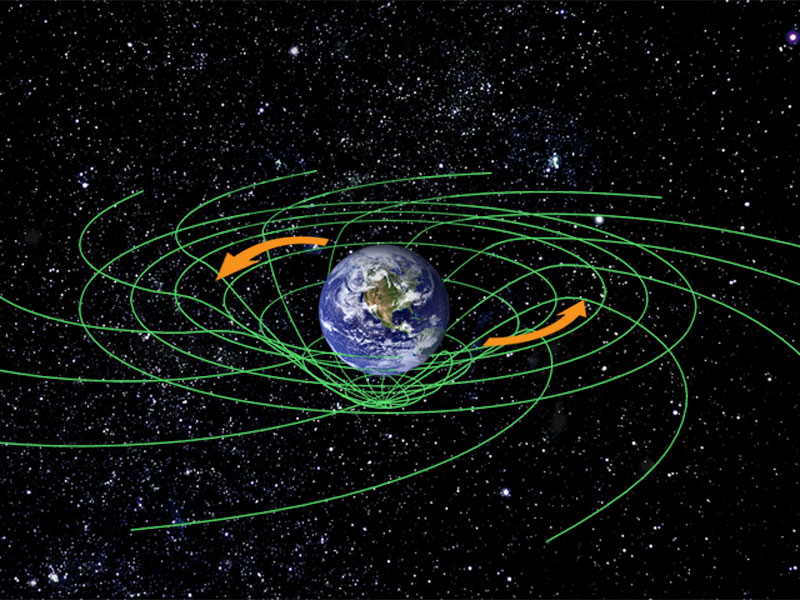
"1.The geodetic effect—the amount by which the Earth warps the local spacetime in which it resides.
2.The frame-dragging effect—the amount by which the rotating Earth drags its local spacetime around with it."(GP-B Mission)
The Geodetic effect is an essential component of the General Relativity theory, as it rests upon the tenet that mass can warp space-time. This allows for the existence of black holes, quasars, and other space phenomena.
The frame dragging effect had never been tested before. It can be visualized as a ball spinning in a bowl of a thick liquid such as syrup. As it spins it drags the syrup in a spiral around it.
In theory testing relativity is a simple concept. According to GP-B Mission;
"1.Place a gyroscope and a telescope in a polar-orbiting satellite, 642 km (400 mi) above the Earth. (GP-B actually uses four gyroscopes for redundancy.)
2.At the start of the experiment, align both the telescope and the spin axis of each gyroscope with a distant reference point—a guide star.
3.Keep the telescope aligned with the guide star for a year, as the spacecraft makes over 5,000 orbits around the Earth, and measure the change in the spin-axis alignment of each gyro over this period in both the plane of the orbit (the geodetic precession) and orthogonally in the plane of the Earth's rotation (frame-dragging precession).
The predicted geodetic gyro-spin-axis precession is a tiny angle of 6,606 milliarcseconds (0.0018 degrees) in the orbital plane of the spacecraft. The orthogonal frame-dragging precession is a minuscule angle of 39 milliarcseconds (1.1x10⁻⁵ degrees). "
Links:
Official Site
NASA GP-B Mission
Paper model of the Spacecraft

Sincerely, Space Cadet
Friday, April 15, 2011
50th Anniversary of Human Space Flight
The 12th of April marked the 50th anniversary of human spaceflight. On that day in 1961 Yuri Gagarin, a soviet Military Pilot, became the first human to orbit the earth. This event had a lot of political implications, as it seemed the Russians would beat the Americans in the dominance of space. Previously the Russians had already put the first satellite, sputnik 1, and the first animal, a dog named Laika (literally translated means "Barker") . All of these victories to the Russians. were a major blow to the Americans and their pride. The Americans caught up soon, and ultimately won the race to dominate space in 1969 as Neil Armstrong stepped upon the moon.
Sincerely, Space Cadet

Sincerely, Space Cadet

Friday, April 1, 2011
Update on the MESSENGER- found Mariner 10 spacecraft
The messenger team was surprised to notice a strange object in one of the photos that the Messenger spacecraft sent back today(April 1st). The image, first thought a imaging artifact, upon close examination was recognized as the Mariner 10. The Mariner was a space probe that was sent in 1973 to swing by mercury and take photos. The space probe visited mercury 3 times, then lost contact. It was not heard of until today. However, based upon its orbit it should not have been near mercury at this time. It is calculated that the space probe's orbit as altered by changes in solar radiation and multiple outgassing events by the residual propellant caused changes in the trajectory of the probe. It does not appear that the probe will be in the way of the messenger in the next few orbits.
Sourced:messenger.jhuapl.edu

Sourced:messenger.jhuapl.edu

Wednesday, March 30, 2011
MESSENGER- Historic Mercury Photographs
Yesterday, March 29, a historic photo of mercury was taken by the Messenger spacecraft.The Messenger is the first orbiting satellite around Mercury. Its first photo of the terrain was recieved on earth March 29. Previous photos of Mercury had been taken by the Mariner, though the Mariner program was just a flyby. Currently the spacecraft has sent back to earth over 300 photos, and is working on global mapping of the planet. According to wikipedia, "the mission is designed to clear up six key issues: Mercury’s high density, its geological history, the nature of its magnetic field, the structure of its core, whether it has ice at its poles, and where its tenuous atmosphere comes from."
More info:
NASA Messenger
MESSENGER official site


More info:
NASA Messenger
MESSENGER official site

Sunday, February 13, 2011
Albatros D.I

The German Fokker E-1 paved the way for more advanced fighters during WWI. the Fokker company produced more of the E series, continuing the synchronized machine gun with the propeller. However the Allied forces had built the Airco D.H.2 and the Nieuport 11 which proved to be superior to the E series in combat. As a response, the Germans employed the Albatros D1. This plane had a different design, consisting of a single shell around minimal interior structure. This lightened the load, and increased the effectiveness of the aerodynamic surfaces. The D1 was not as good in manuvering, but had superior fire power and speed (110 mph ) giving it superiority over the planes of the allied forces.
Specifications (from wikipedia)
- Crew: one pilot
- Length: 7.40 m (23 ft 3.5 in)
- Wingspan: 8.50 m (27 ft 11 in)
- Height: 2.95 m (9 ft 8 in)
- Wing area: 22.9 m² (247 ft²)
- Empty weight: 645 kg (1,422 lb)
- Gross weight: 898 kg (1,809 lb)
Performance
- Maximum speed: 175 km/h (110 mph)
- Endurance: 1.5 hours
- Service ceiling: 3,000 m (9,840 ft)
- Rate of climb: 2.8 m/s (547 ft/min)
Armament
- 2 × forward-firing 7.92 mm (.312 in) LMG 08/15 machine guns
Thursday, February 10, 2011
Fokker E-1

Airplanes, previously viewed as "toys", gained new meaning during WWI. A battle was found to be more effective with a reconnaissance mission carried out by a scout plane, though due to the weight that the early airplanes could handle, bombs were not much of an option until planes that could handle larger loads were built. One of the first true armed aircraft, meant for aerial combat was built by the Germans, the Fokker E-1. It was the first plane to mount the machine gun on the front of the aircraft, positioned behind the propeller. It synchronized the firing of the gun with the rotation of the propeller.
The Fokker E-1 was designed to roll using wing warping via acables attached to the wing. The plane was built of welded steel tubes, covered in fabric. It had a single machine gun, a 7.92 mm Parabellum LMG 14 or Spandau LMG 08 machine gun, affixed to the front of the aircraft, behind the propeller. It was employed to the Fliegertruppe of the German Army.
The Fokker E-1 was an important stepping stone in the development of fighters. More advanced fighters were developed and used by many countries during WWI.
Specifications (from Wikipedia)
Fokker E-1
Crew: one, pilot
Length: 7.22 m (23 ft 7 in)
Wingspan: 8.85 m (29 ft 0 in)
Height: 2.9 m (9 ft 5½ in)
Wing area: 15.9 m² (172.2 ft²)
Empty weight: 360 kg (789 lb)
Loaded weight: 563 kg (1,241 lb)
Powerplant: 1× Oberursel U.0 7-cylinder air-cooled rotary engine (clone of Gnôme Lambda engine) using various makes of 2-blade propellers, from 2.3 to 2.5 meters (7.55 to 8.20 ft) diameter, 80 hp (60 kW)
Performance
Maximum speed: 130 km/h (81 mph)
Range: 198 km at 110 km/h (123 mi at 68 mph)
Service ceiling: 3,000 m (9,840 ft)
Rate of climb: 20 min to 2,000 m (6,560 ft)
Armament
- 1 × forward-firing 7.92 mm (.312 in) Spandau lMG 08 machine gun (one Parabellum MG14 M/G on prototypes
Sincerely, Space Cadet
Friday, January 21, 2011
New Changes for the space program

In 2010 President Barack Obama announced new goals for the American Space Program. These change how we, as Americans, will dominate space, and also where our money goes. Some of these new goals will improve the space program, whereas others may be have a devastating effect on the American Space Program.
One of the most controversial changes to the space program was the cancellation of the Constellation program (CxP). According to three Apollo Astronauts,Neil Armstrong, James Lovell and Eugene Cernan, this “decision to cancel the Constellation program, its Ares 1 and Ares V rockets, and the Orion spacecraft, is devastating.”1 The constellation program was designed to keep an American foothold in the frontier of space, to return to the moon and possibly mars. However, President Obama said the program is "behind schedule, and lacking in innovation"2. The cancellation of the CxP has a lot of political implications because we have to rely on the International Space Station (ISS). The ISS is a result of international partnership with other nations, particularly Russia. According to the agreement we made with the Soviet Nation we have to pay a fee to Russia for the seat in space.
Not all changes to the space program are negative. One positive change will be the use of private industry for crew and cargo services to the International Space Station. In 2004 Astronaut Mike Melville successfully flew Space Ship one into space. Not only did he win the X-prize, but launched a new age of space travel- Private Investors. Companies such as Space-X are now entering the field of space. Now, with access to the ISS, Private Companies are taking another step into this frontier. I believe this is a positive investment. Through these companies America may still keep their name in Space.
The President is also putting a new focus onto Green Aviation. NASA researchers have recently, as of September 21st, resumed working on the X-48b. This has a Blended wing body designed specifically for that purpose. The Blended Wing Body is a plane design, where the entire plane is a lifting surface. This design is less noisy and more fuel efficient than it's predecessor, the tube design. This plane is controlled by a pilot on the ground, via cameras in the front, The design will be integrated into future airliners.
Also included in the new plan is a new focus on robotic space exploration. This program will send a series of robotic missions to explore the solar system. These robots will pave the way for future manned spaceflight. However, with the cancellation of the CxP, it will take much longer, and will take more money, to get us on other planets.
NASA will be putting a new focus on education, through the STEM Program. STEM stands for Science, Technology, Engineering and Mathematics. Through STEM, NASA will educate students of all ages, and teachers. Some of these students may become NASA's future, working to keep the American Space Program alive.
The new changes to NASA's goals will change the future of the american space program. Some changes are positive. Our Nation will have “quieter, cleaner, and more fuel-efficient airplanes for the future.”3 because of new technology being developed. Students are being educated through STEM to help keep our space program alive. Private Space companies will keep us in space. However some changes are for the worse, such as the cancellation of the Constellation Program. This “devastating” blow to NASA will be a backwards step in our foothold in the space frontier.
Quotes:
1 http://www.msnbc.msn.com/id/36470363
2 http://news.bbc.co.uk/2/hi/science/nature/8489097.stm
3 http://www.nasa.gov/centers/dryden/status_reports/X-48B_status_09_21_10.html
Sources:
http://newfrontiersblog.blogspot.com/search/label/constellation
sincerely, space cadet
One of the most controversial changes to the space program was the cancellation of the Constellation program (CxP). According to three Apollo Astronauts,Neil Armstrong, James Lovell and Eugene Cernan, this “decision to cancel the Constellation program, its Ares 1 and Ares V rockets, and the Orion spacecraft, is devastating.”1 The constellation program was designed to keep an American foothold in the frontier of space, to return to the moon and possibly mars. However, President Obama said the program is "behind schedule, and lacking in innovation"2. The cancellation of the CxP has a lot of political implications because we have to rely on the International Space Station (ISS). The ISS is a result of international partnership with other nations, particularly Russia. According to the agreement we made with the Soviet Nation we have to pay a fee to Russia for the seat in space.
Not all changes to the space program are negative. One positive change will be the use of private industry for crew and cargo services to the International Space Station. In 2004 Astronaut Mike Melville successfully flew Space Ship one into space. Not only did he win the X-prize, but launched a new age of space travel- Private Investors. Companies such as Space-X are now entering the field of space. Now, with access to the ISS, Private Companies are taking another step into this frontier. I believe this is a positive investment. Through these companies America may still keep their name in Space.
The President is also putting a new focus onto Green Aviation. NASA researchers have recently, as of September 21st, resumed working on the X-48b. This has a Blended wing body designed specifically for that purpose. The Blended Wing Body is a plane design, where the entire plane is a lifting surface. This design is less noisy and more fuel efficient than it's predecessor, the tube design. This plane is controlled by a pilot on the ground, via cameras in the front, The design will be integrated into future airliners.
Also included in the new plan is a new focus on robotic space exploration. This program will send a series of robotic missions to explore the solar system. These robots will pave the way for future manned spaceflight. However, with the cancellation of the CxP, it will take much longer, and will take more money, to get us on other planets.
NASA will be putting a new focus on education, through the STEM Program. STEM stands for Science, Technology, Engineering and Mathematics. Through STEM, NASA will educate students of all ages, and teachers. Some of these students may become NASA's future, working to keep the American Space Program alive.
The new changes to NASA's goals will change the future of the american space program. Some changes are positive. Our Nation will have “quieter, cleaner, and more fuel-efficient airplanes for the future.”3 because of new technology being developed. Students are being educated through STEM to help keep our space program alive. Private Space companies will keep us in space. However some changes are for the worse, such as the cancellation of the Constellation Program. This “devastating” blow to NASA will be a backwards step in our foothold in the space frontier.
Quotes:
1 http://www.msnbc.msn.com/id/36470363
2 http://news.bbc.co.uk/2/hi/science/nature/8489097.stm
3 http://www.nasa.gov/centers/dryden/status_reports/X-48B_status_09_21_10.html
Sources:
http://newfrontiersblog.blogspot.com/search/label/constellation
sincerely, space cadet
Friday, January 7, 2011
Blended wing Bodies- the plane of the future

Research in the fields of Aerodynamics has increased our knowledge of flight and how to design better wing surfaces. This Knowledge is being put into action by the NASA Engineers. The engineers integrated a Blended wing Body in their design, successfully creating the X-48b, a step forward in creating "quieter, cleaner, and more fuel-efficient airplanes for the future"(NASA)
The Blended Wing Design means that the entire plane is a lifting surface, not just the wings. 

This design has several advantages. The design is less noisy, so people will not be as bothered living in a house by an airport. It has better lift and uses less fuel, which may decrease the price on your plane ticket.I
However, there is no such thing as a free lunch. Disadvantages come in the package. Because of the positioning of the cargo, which creates less flight stability than the tube design. The tube design is more structurally sound than the x-48b. Also windows are not available, due to the entire plae being a wing.
Despite these disadvantages, this plane could be the aircraft of the future. As this experimental plane is unmanned, being remote controlled by a pilot on the ground, it's design will be incorporated into airliners in the near future.
Sincerely, Space Cadet
Railguns

Railguns are a topic that have been included in countless Sci-Fi media. The American Department of the Navy has been working to make this idea a reality.
What is a Railgun? It is a "Weapon, consisting mainly of conducting metal rails, that uses electromagnetic force to accelerate a projectile to a much greater speed than achieved"
It was idealized as the "perfect weapon". Using electromagnetic propulsion would eliminate the need for ammunition, thereby making a much safer ship to sail on. Making it a reality was much harder than expected. The projectile moved so fast that the friction melted the gun. Once they fixed that problem, the projectile vaporized when it entered the atmosphere. Also they had to solve the problem of power. The Navy is designing a new battleship so that the power will be derived from the main engine.
Dec 10, 2010 the NAVY succesfully launched the projectile through the railgun at Naval Surface Warfare Center Dahlgren Division. At launch the projectile had 33 Megajoules- 1 Megajoule is the equivalent of a 1-ton ar traveling a 100 mph. It demolished the target at impact an set the guinness world record for most energy upon launch. Much more than had been achieved by ammunition.
Sincerely, Space Cadet

Saturday, December 4, 2010
Aerospace Power: Defending our country

America's Aerospace power has made available advanced defense systems which we use today. During the Cold War we developed a system of satellites called the Defense Support Program (DSP) to spot ballistic missiles from space.
The first DSP Satellite was launched from Cape Canveral in 19 70. It tracked missiles using infrared sensors to sense the heat emitted when it launched and sent that data to hidden command centers, such as NORAD.
Now we are currently developing more advanced systems to help defend our country. A System that has currently undergone some tests is the “Space-Based Infrared System” (SBIR). This system is designed to replace the DSP. It has advanced features expanded capabilities for intelligence, surveillance and reconnaissance (ISR)missions.
Sincerely,
Space Cadet
Saturday, October 30, 2010
Bottle Rockets and Newton's Laws
“Elephant Toothpaste” Bottle Rocket
This bottle rocket demonstrates the three laws that Isaac Newton discovered. If you use non-toxic soap, the foam that is produced is perfectly safe, as it is just bubbles filled with oxygen.
Warning: Lean back when launching, or you will be drenched in foam!
Supplies:
Yeast
Hydrogen Peroxide (3%)
Dish Soap
Water Bottle, small mouth
Cork
Scrap wood
Nail
Duct Tape (if necessary)
Funnel
1. Launching Pad:
Take a Cork and test-fit it in the mouth of the water bottle. If it is too small, wrap duct-tape around it until it fits perfectly. Nail the bottom of the cork to a long piece of scrap wood. This is your launching platform.
2. Yeast:
Measure 1 Packet (1 Tbs) of Yeast into a cup. Add 3 Tbs of warm water, and stir thoroughly. This will act as a catalyst to speed up the decomposition of the hydrogen peroxide. Set aside.
3. Bottle Rocket:
Using the funnel, pour 1 tbs of Dish Soap into the water bottle. Then pour ½ cup of Hydrogen Peroxide into the bottle.
4. Blastoff!:
Take the bottle, with soap/peroxide solution inside and put a funnel in it. This part of the experiment must be done as quickly as possible. Pour the yeast/water mixture into the funnel, and quickly take the funnel out, take the cork, attached to the launch stand and plug the bottle. Flip the launch stand over and stand back, or else you will be covered with foam. The rocket will shoot high, streaming out foam behind it.
What Happened?
The yest acted as a catalyst and separated the oxygen from the hydrogen peroxide. This oxygen bubbled up as a gas, and was encapsulated by the soap creating millions of tiny bubbles. This foam expanded fast. This foam pressurized the inside of the bottle, until it shot off the cork and propelled the rocket in the sky.
How does this apply to Newton's laws?
The Rocket was in a state of rest, but when a force acts upon the rocket (the propellant), the rocket is now in a state of motion (Newton's law #1). How much force is put in the rocket determines how high it goes. The force depends upon the mass(weight) of the rocket and how much it is accelerating (Newton's Law #2). Because the propellant pushed downward, the rocket shot upwards, with the same amount of Force pushing downwards (Newton's law #3)
Enjoy!, Space Cadet
Sunday, April 11, 2010
Bluebonnet Airshow
I got to work at the Bluebonnet Airshow on the 10th because the Civil Air Patrol helps out the Commemorative Air Force. It was a very exiting day. For the most part some other cadets and I helped make sure the crowd stayed behind the line all day, while watching the planes. My most favorite part of the airshow was either the Extra 300 aerobatic performance of the A-10 West Coast Demo Team. Here is a little history of both:
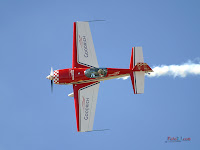 The Extra 300 was designed in 1987 by Walter Extra. It was built out of welded steel tubes for the framework and covered with fiberglass and cloth. It was built extremely light for optimum aerobatic performance. During the airshow, it performed amazing aerobatic maneuvers, including a square loop and a tail slide.
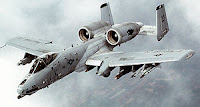 The A-10 was designed in the early 70's by Fairchild Republic. It was designed for Close Air Support (CAS), by shooting at tanks, armored vehicles and other unlucky ground targets. It has excellent Aerobatic capabilities at low speeds. It was designed with special "skin" that can survive direct hits up to 23mm. It was built around the GAU-8 Avenger, a heavy automatic cannon that can fire 4,200 rounds a minute using 30mm rounds. The pyrotechnics were amazing!
 The Extra 300 was designed in 1987 by Walter Extra. It was built out of welded steel tubes for the framework and covered with fiberglass and cloth. It was built extremely light for optimum aerobatic performance. During the airshow, it performed amazing aerobatic maneuvers, including a square loop and a tail slide.
 The A-10 was designed in the early 70's by Fairchild Republic. It was designed for Close Air Support (CAS), by shooting at tanks, armored vehicles and other unlucky ground targets. It has excellent Aerobatic capabilities at low speeds. It was designed with special "skin" that can survive direct hits up to 23mm. It was built around the GAU-8 Avenger, a heavy automatic cannon that can fire 4,200 rounds a minute using 30mm rounds. The pyrotechnics were amazing!
I had fun and learned a lot. I hope to come back next year!
Wednesday, March 31, 2010
George Nelson pt1


Yesterday I went to UT, where I got to listen to a lecture by former NASA astronaut George Nelson. I had fun and learned a lot. He talked about the space race, his personal life and where we are headed.
George Nelson received a bachelor’s degree in physics from Harvey Mudd College in California and later earned a master’s and doctorate in astronomy from the University of Washington.
He said he started his space career when he saw a NASA flyer that said that it needed astronauts for the shuttle missions. He realized that he had all the prerequisites so he filled in the form and sent it in. A couple months later he found out that he had been selected, along with several hundred others, to have a week-long psychological test. NASA would single out a few to become astronauts. One of the tests, as Nelson recalled was "They zipped you up in a three-foot cloth sphere, with your own personal rebreather. They left me in for a long time, I don't know how long because I fell asleep :). I think they were testing me for claustrophobia."Nelson was one of the few that got selected.
He flew STS-41C, STS-61-C (the mission before the Challenger accident) and STS-26 (the mission directly after the Challenger accident) On his first mission he was the first person to do an EVA untethered. He logged 411 hrs in space, 10 of them EVAs.
In his lecture he was talking abouut where the American Space Program is going. As far as he can tell- nowhere. “I’m a bit nervous about where the space program is going at the moment,” Nelson said. “Do we need another Sputnik to kick us in the rear and inspire us to do something?”
Here is a really neat video on Nelson's first mission (STS-41C) with a commentary by the astronauts of this mission:
Enjoy!
Sincerely, Space Cadet
Thursday, March 11, 2010
Start of the Space Race - Sputnik 1

On October 4th 1957 something happened that rocked the world - the first man-made object was intentionally launched into space- the launch of Sputnik1. What rocked the world most about it was that it was made by the Russians, not the Americans. That one launch ingnited (literally) a series of events called the Space Race in which America and Russia were competing over space exploration.
Sputnik 1 was a metal sphere about 23" in diameter with 4 long antannae. The heat shield was 1 mm thick and made of made of aluminum-magnesium-titanium. It released a signal that could be picked up by amature radio operators around the world. It also collected data from the atmosphere, which it sent back by radio signal. It identified the upper atmosphere density and provided data on radio-signal distribution in the ionosphere. It continued to send out signals for 22 days, then it's battery ran out. It finnally fell to earth and burned up in the atmosphere on the 4th of January 1958
The launch of sputnik was an important milestone in history. It put pressure on Americans to win the space race and inspired many rocket scientists such as Homer Hickam.
Sincerely, Space Cadet
Sputnik 1 was a metal sphere about 23" in diameter with 4 long antannae. The heat shield was 1 mm thick and made of made of aluminum-magnesium-titanium. It released a signal that could be picked up by amature radio operators around the world. It also collected data from the atmosphere, which it sent back by radio signal. It identified the upper atmosphere density and provided data on radio-signal distribution in the ionosphere. It continued to send out signals for 22 days, then it's battery ran out. It finnally fell to earth and burned up in the atmosphere on the 4th of January 1958
The launch of sputnik was an important milestone in history. It put pressure on Americans to win the space race and inspired many rocket scientists such as Homer Hickam.
Sincerely, Space Cadet
Wednesday, February 24, 2010
Edwin Hubble

Edwin Hubble was an American astronomer who totally changed our perspective on the universe. As a young man he got a Rhodes scholarship in law from Oxford and spent a year as a lawyer. He soon found out that he was bored with law so he served in the army during WWI rising to the rank of major. Afterwards he studied hard at Yerkes Observatory of the University of Chicago and got a PhD in astronomy. He then got a job at the Mount Wilson Observatory where he discovered many things.
Edwin Hubble’s discoveries:
- There are other galaxies besides ours
- Hubble’s Law- the universe is expanding
- Classification system for stars
- Discovered the asteroid 1373 Cincinnati
Had Edwin Hubble not died in 1953, he would have received the Nobel prize for physics. Hubble will always be remembered as the “Father of Observational Cosmology”.
Subscribe to:
Posts (Atom)