Sunday, May 15, 2011

Newton and Einstein- Gravity

     In 1916, Einstein published his theory of General Relativity, radically changing the way we view gravity. Over 200 years earlier, Newton published his "law of universal gravitation" in Principia Mathematica. Newton's view of gravity held that gravity was a force. This force is the attraction of mass to mass, the larger mass having a stronger pull on the smaller mass, and the smaller mass pulled upon the larger with less force. To this day Newton's gravitational equation is used to approximate a given object's weight upon a given planet.

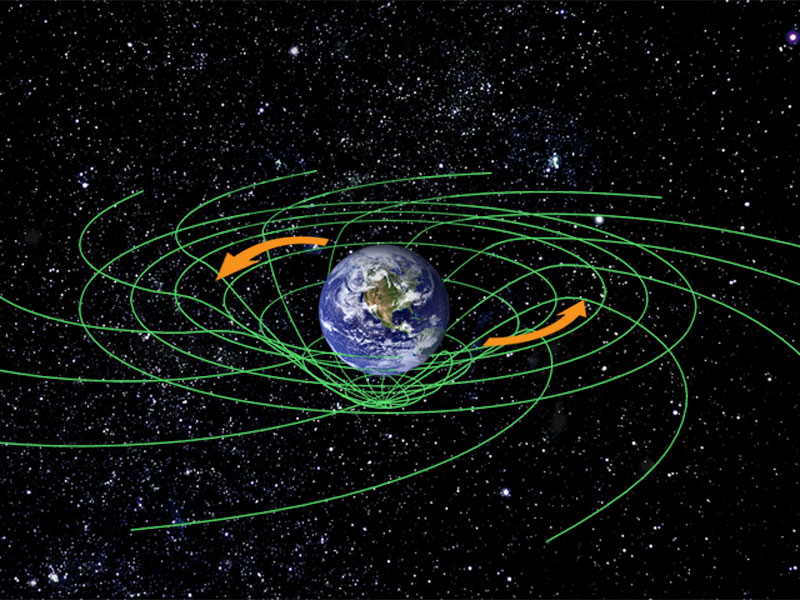
 However, Einstein saw gravity in a different light. He supposed that mass could bend the fabric of space-time, much like a bowling ball on a trampoline. A smaller mass, like a planet, would simply follow the geodesic curve in an acceleration percieved as a force.
Since 1916, Einstein's theory has been shown to be accurate over the years, as certain  points are proven, such as the GP-B probe and the proof that gravity acts at the speed of light. His theory also covers other important points (such as Gravitational lensing) to be mentioned in a later post.
Sincerely,
Space Cadet

Monday, May 9, 2011

Gravity Probe B - Testing Einstein's Theories

Gravity Probe B has tested- and proven,  two effects of the general relativity theory developed by Albert Einstein developed in 1916. Orbiting around the earth, the spacecraft has the perfect opportunity to measure this, as the earth itself is a large enough mass to warp space-time noticably. The sensitive gyroscopic sensors were able to prove:
"1.The geodetic effect—the amount by which the Earth warps the local spacetime in which it resides.


2.The frame-dragging effect—the amount by which the rotating Earth drags its local spacetime around with it."(GP-B Mission)
The Geodetic effect is an essential component of the General Relativity theory, as it rests upon the tenet that mass can warp space-time. This allows for the existence of black holes, quasars, and other space phenomena.
The frame dragging effect had never been tested before. It can be visualized as a ball spinning in a bowl of a thick liquid such as syrup. As it spins it drags the syrup in a spiral around it.
In theory testing relativity is a simple concept. According to GP-B Mission;
 
"1.Place a gyroscope and a telescope in a polar-orbiting satellite, 642 km (400 mi) above the Earth. (GP-B actually uses four gyroscopes for redundancy.)


2.At the start of the experiment, align both the telescope and the spin axis of each gyroscope with a distant reference point—a guide star.

3.Keep the telescope aligned with the guide star for a year, as the spacecraft makes over 5,000 orbits around the Earth, and measure the change in the spin-axis alignment of each gyro over this period in both the plane of the orbit (the geodetic precession) and orthogonally in the plane of the Earth's rotation (frame-dragging precession).

The predicted geodetic gyro-spin-axis precession is a tiny angle of 6,606 milliarcseconds (0.0018 degrees) in the orbital plane of the spacecraft. The orthogonal frame-dragging precession is a minuscule angle of 39 milliarcseconds (1.1x10⁻⁵ degrees). "
Links:
Official Site
NASA GP-B Mission
Paper model of the Spacecraft


Sincerely, Space Cadet

Friday, April 15, 2011

50th Anniversary of Human Space Flight

     The 12th of April marked the 50th anniversary of human spaceflight. On that day in 1961 Yuri Gagarin, a soviet Military Pilot, became the first human to orbit the earth. This event had a lot of political implications, as it seemed the Russians would beat the Americans in the dominance of space. Previously the Russians had already put the first satellite, sputnik 1, and the first animal, a dog named Laika (literally translated means "Barker") . All of these victories to the Russians. were a major blow to the Americans and their pride. The Americans caught up soon, and ultimately won the race to dominate space in 1969 as Neil Armstrong stepped upon the moon.
Sincerely, Space Cadet


Friday, April 1, 2011

Update on the MESSENGER- found Mariner 10 spacecraft

The messenger team was surprised to notice a strange object in one of the photos that the Messenger spacecraft sent back today(April 1st). The image, first thought a imaging artifact, upon close examination was recognized as the Mariner 10. The Mariner was a space probe that was sent in 1973 to swing by mercury and take photos. The space probe visited mercury 3 times, then lost contact. It was not heard of until today. However, based upon its orbit it should not have been near mercury at this time. It is calculated that the space probe's orbit as altered by changes in solar radiation and multiple outgassing events by the residual propellant caused changes in the trajectory of the probe. It does not appear that the probe will be in the way of the messenger in the next few orbits.
Sourced:messenger.jhuapl.edu

Wednesday, March 30, 2011

MESSENGER- Historic Mercury Photographs

Yesterday, March 29, a historic photo of mercury was taken by the Messenger spacecraft.The Messenger is the first orbiting satellite around Mercury. Its first photo of the terrain was recieved on earth March 29.  Previous photos of Mercury had been taken by the Mariner, though the Mariner program was just a flyby. Currently the spacecraft has sent back to earth over 300 photos, and is working on global mapping of the planet. According to wikipedia, "the mission is designed to clear up six key issues: Mercury’s high density, its geological history, the nature of its magnetic field, the structure of its core, whether it has ice at its poles, and where its tenuous atmosphere comes from."
More info:
NASA Messenger 
MESSENGER official site


Sunday, February 13, 2011

Albatros D.I


The German Fokker E-1 paved the way for more advanced fighters during WWI. the Fokker company produced more of the E series, continuing the synchronized machine gun with the propeller. However the Allied forces had built the Airco D.H.2 and the Nieuport 11 which proved to be superior to the E series in combat. As a response, the Germans employed the Albatros D1. This plane had a different design, consisting of a single shell around minimal interior structure. This lightened the load, and increased the effectiveness of the aerodynamic surfaces. The D1 was not as good in manuvering, but had superior fire power and speed (110 mph ) giving it superiority over the planes of the allied forces.
Specifications (from wikipedia)
  • Crew: one pilot
  • Length: 7.40 m (23 ft 3.5 in)
  • Wingspan: 8.50 m (27 ft 11 in)
  • Height: 2.95 m (9 ft 8 in)
  • Wing area: 22.9 m² (247 ft²)
  • Empty weight: 645 kg (1,422 lb)
  • Gross weight: 898 kg (1,809 lb)

Performance

  • Maximum speed: 175 km/h (110 mph)
  • Endurance: 1.5 hours
  • Service ceiling: 3,000 m (9,840 ft)
  • Rate of climb: 2.8 m/s (547 ft/min)

Armament

  • 2 × forward-firing 7.92 mm (.312 in) LMG 08/15 machine guns

Thursday, February 10, 2011

Fokker E-1


Airplanes, previously viewed as "toys", gained new meaning during WWI. A battle was found to be more effective with a reconnaissance mission carried out by a scout plane, though due to the weight that the early airplanes could handle, bombs were not much of an option until planes that could handle larger loads were built. One of the first true armed aircraft, meant for aerial combat was built by the Germans, the Fokker E-1. It was the first plane to mount the machine gun on the front of the aircraft, positioned behind the propeller. It synchronized the firing of the gun with the rotation of the propeller.

The Fokker E-1 was designed to roll using wing warping via acables attached to the wing. The plane was built of welded steel tubes, covered in fabric. It had a single machine gun, a 7.92 mm Parabellum LMG 14 or Spandau LMG 08 machine gun, affixed to the front of the aircraft, behind the propeller. It was employed to the Fliegertruppe of the German Army.

The Fokker E-1 was an important stepping stone in the development of fighters. More advanced fighters were developed and used by many countries during WWI.
Specifications (from Wikipedia)

Fokker E-1

  • Crew: one, pilot

  • Length: 7.22 m (23 ft 7 in)

  • Wingspan: 8.85 m (29 ft 0 in)

  • Height: 2.9 m (9 ft 5½ in)

  • Wing area: 15.9 m² (172.2 ft²)

  • Empty weight: 360 kg (789 lb)

  • Loaded weight: 563 kg (1,241 lb)

  • Powerplant: 1× Oberursel U.0 7-cylinder air-cooled rotary engine (clone of Gnôme Lambda engine) using various makes of 2-blade propellers, from 2.3 to 2.5 meters (7.55 to 8.20 ft) diameter, 80 hp (60 kW)

Performance


  • Maximum speed: 130 km/h (81 mph)

  • Range: 198 km at 110 km/h (123 mi at 68 mph)

  • Service ceiling: 3,000 m (9,840 ft)

  • Rate of climb: 20 min to 2,000 m (6,560 ft)

Armament

  • 1 × forward-firing 7.92 mm (.312 in) Spandau lMG 08 machine gun (one Parabellum MG14 M/G on prototypes

Sincerely, Space Cadet